Showing posts with label blogging. Show all posts

Tuesday, 1 November 2022

Meet the Author: Shae Millward

Shae Millward is the author of The Rabbit’s Magician, Koalas Like To and A Boy and a Dog. Shae is an enthusiastic advocate for literacy. She aims to inspire through a love of books, the joy of reading and writing, and the art of storytelling. Shae enjoys writing picture books, poetry, song lyrics, funny or inspirational quotes, short stories and more. Shae’s creative writing skills once helped her win a trip to Disneyland!


Website: https://shaemillward.com/

Facebook: https://www.facebook.com/shaemillwardauthor/

Instagram:  https://www.instagram.com/shaemillward/

Twitter:  https://twitter.com/shaemillward


What was your first book published?

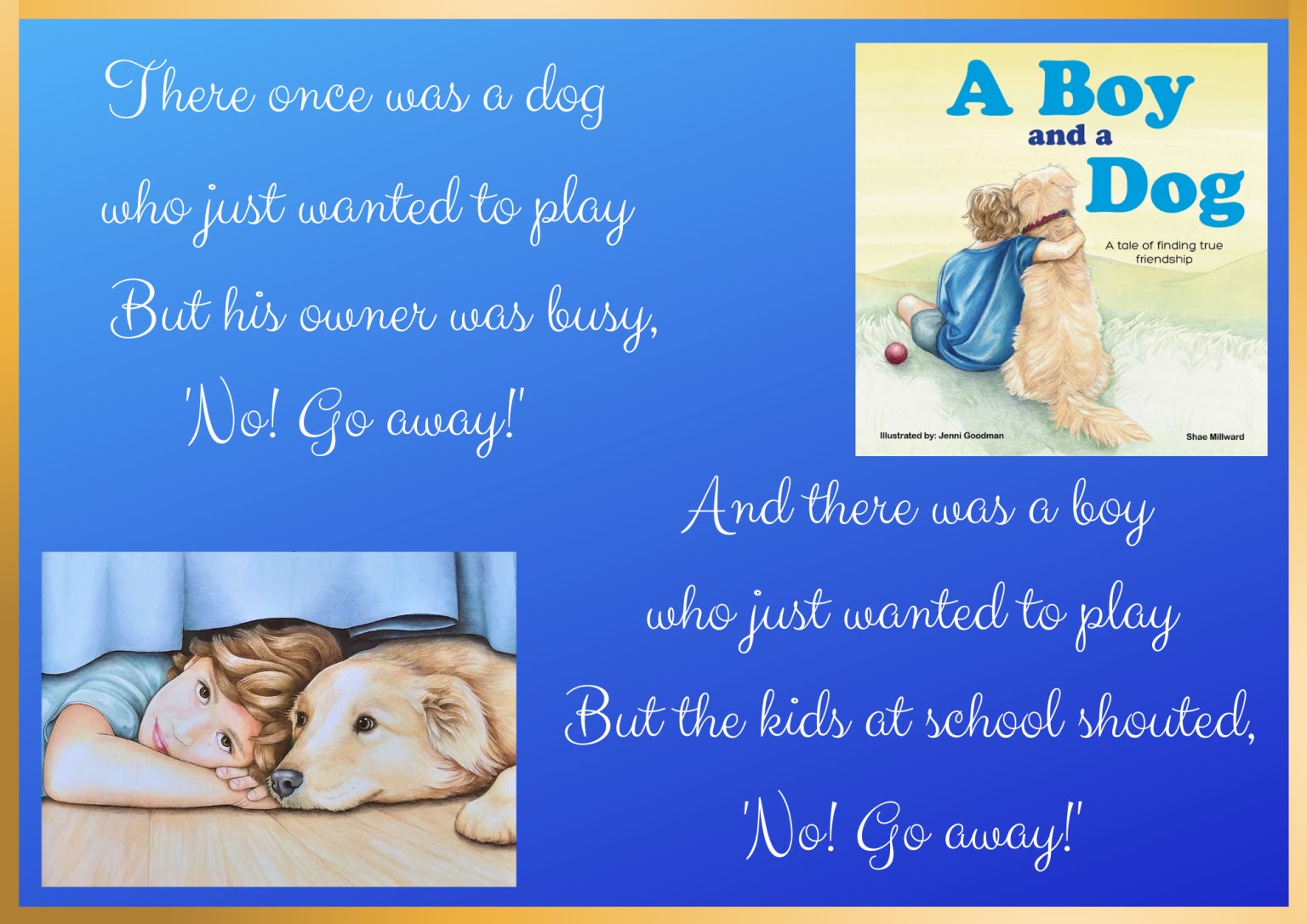
There once was a dog who just wanted to play,
But his owner was busy, ‘No! Go away!’
And there was a boy who just wanted to play,
But the kids at school shouted, ‘No! Go away!’

A Boy and A Dog tells the timeless tale of a lonely boy and a lonesome dog who find each other and discover true friendship. A Boy and A Dog celebrates the special bond between children and animals. This book contains the universal themes of trust, joy, compassion and belonging. But at its heart, it's a story about love.


Tell us about your newest book?

The Rabbit’s Magician:

* Is a gentle story of love, loss & comfort.

* Is inspired by a fundamental law of nature: Energy cannot be created or destroyed, but it can change from one form into another.

* Contains references to and representations of the moon and its phases.

* Is a children's picture book, but offers comfort to anyone of any age who has lost a loved one – person or animal. 

*Is illustrated by Andy Fackrell and published by Ford Street Publishing.


What is your favourite part about being an author?

The tiny town I grew up in didn’t have a bookstore, but the library was ONLY ONE SMALL BLOCK AWAY FROM MY HOUSE! Convenient for frequent visits and lugging books back and forth. I’ve always loved books and reading, and I have many wonderful authors to thank for that. So, to now be a part of the industry myself is an exquisite type of joy.

As well as being a whole lotta fun, there’s something quite magical about working with or rather, playing with imagination and creative energies.


What is the hardest part about being an author?

Being on the Autism spectrum has its positives, like unique perspectives and creative thinking, but it also has its challenges, with social communication being one. Just think awkward, so awkward, haha!


I’m grateful to have a supportive publisher who allows me to play to my strengths. Fortunately, these days there are a good variety of promotional avenues one can partake in.


Books On Tour PR & Marketing has a number of packages, and options within, which you can tailor to your needs. Romi is a superstar – super helpful and brilliant to work with.


Having an illustrator who is also active in promoting – which Andy is – certainly helps and provides team spirit. *enthusiastically does spirit fingers*


What was your favourite children’s book when you were a kid?

As a child, when I asked for Fox in Socks, I could almost hear the adults groan internally and I’m certain I saw beads of dread gather on their foreheads. Watching them get their tongues twisted and tangled and tied up in knots was definitely part of the entertainment value. And by the end, they looked like they’d been through a harrowing ordeal.


Yet every time I asked for this story (which was a lot), they would not only read it (after casually suggesting a range of alternative titles), but read it with all the enthusiasm they could muster. Anyone who has ever read the same book over and over (until you are well and truly over it!) at a child’s request knows that this is an act of real love!


Have you ever travelled overseas as an author?

I once had to step over a puddle on my way to a meeting about authorly business. Does that count?

It was a very large puddle. It carried a dangerously-high sock-wetting threat level.

And the puddle was deep. So deep, just like my answer to this question.


Have you met anyone even more famous than you that was exciting?

Yes, I met you – the inspirational Michelle Worthington! It was at the Teddy Bear’s Picnic in Hervey Bay. I didn’t have any books published at the time, but I did have a contract for my first. I went along to say hi and you were happy to have a chat. I was able to purchase some of your wonderful books from you in person and get them signed – bonus!


Where do you see the future of children’s books (ebooks/apps/print)

I’m all for books being available in different formats to suit people’s needs and preferences. These options make books more accessible, which can only have a positive effect on literacy and developing an early love of reading.

Digital books have their benefits, e.g. they’re more convenient than taking a stack of physical books on holiday, but I see them as a supplement to print books, not a replacement. Never a replacement!


What is your favourite way/time to read?

My favourite way to read is definitely with a physical book. I spend enough time working at a computer, so reading for pleasure on a screen is no pleasure at all! Reading a paper book feels more grounded, more intimate. Regardless of genre, reading a print book has a certain kind of romance to it that does not translate to an electronic device. #PrintBeforePixels

My favourite time to read is any time, however, I am an experienced member of the late-night reading club. Our motto is: One more page, just one more page!


What book are you reading right now?

I’m reading a Marie Kondo book about decluttering. I have successfully cleaned out clothing, kitchen stuff and various homewares that don’t spark joy.


Then it came to my book collection. Well, I acknowledge that Marie is super cute and super sweet, but parting with any of my beloved books is a super hideous and super displeasing notion. Sorry, Marie. No Kan Do.


But I’m grateful to now have space in my home for more books.


Monday, 7 June 2021

Reading to Kids Makes Them More Resilient.


Building small humans into healthy, thriving big ones, isn’t about clearing adversity out of their way. Resilience is being able to bounce back from stress, challenge, tragedy, trauma, or adversity. When children are resilient, they’re braver, more curious and adaptable, and more able to extend their reach into the world. Research tells us that it’s not rugged self-reliance, determination, or inner strength that leads kids through adversity, but the reliable presence of at least one supportive relationship. In the context of a loving relationship with a caring adult, children have the opportunity to develop vital coping skills. Just reading with your child for 10 minutes a day from a book they like which touches on subjects like diversity and problem solving, can increase their resilience, help them manage their own behaviour and feelings, and increase their capacity to develop their own coping strategies during tough times.

Saturday, 30 January 2021

As an Author, How can you overcome excessive thinking?


Creating awareness:

It is natural that excessive thinking makes a person distracted and makes them unaware that they are preoccupied with thinking. Creating awareness involves recognizing negative thinking circles when they occur, and to have deliberate awareness of excessive thinking. You will be able to control and stop thinking excessively when you monitor your thoughts and actions. Make sure you do not judge your thoughts or worry about excessive thinking. Mindset is everything.

Replace negative thoughts:
Another tip to eliminate negative thinking is to replace your negative thinking with positive thinking after interrupting your over-thinking style. Repeat your positive thinking many times aloud or with a voice in your mind. If your thinking is persistent, you should repeat this process as many times as you need. Over time, you will overcome the habit of negative thinking.

Talk to a trusted person:
There is also another solution to eliminate excessive thinking, which is to share your negative thoughts with someone you trust. This person can be a coach, mentor, counselor or friend. Such people can help you determine if you are overstated or not thinking clearly and they can also help you free yourself from negative thoughts. Your problem may not be as bad as you think and all you need is someone who assures you that you are fine.

Self-employment:
Keeping your mind busy keeps you from negative thoughts. Anything that requires attention may help you. This concern may vary between arranging your bookshelf alphabetically, drawing or calculating your annual expenses. This way you will gradually control your thoughts until you reach your desired level of control.


Exercise:

In addition to increasing self-confidence, exercise increases the secretion of the hormone Androfen and Sertonin, which reduce symptoms of anxiety and depression. When you concentrate on exercising, it distracts your mind from negative thoughts. When you have a busy mind, do some exercise, bike or walk for half an hour.

Make decisions:
Sometimes excessive thinking comes from inability to make an important decision. The most appropriate solution is to set a time, whether it is half an hour or two, to think about everything about a topic and when the time is close to completion, the decision was to be made without any hesitation.

Blogging:
During excessive thinking, you can not communicate with the present. One way to get rid of excessive thinking is to train your mind on intentional attention. Get to know your negative thoughts and then get rid of them immediately, or blog about it...It makes for great content!

Just do it:
The trick here is to start the project you want to do instead of thinking about it. Focus on your goal and schedule what you want to do so you can solve every problem on time. A step-by-step move will make you spend less time thinking about it.

Stop trying to reach perfection or control everything:
People think about things in exaggerated contexts until they achieve perfect results. You take into account all possibilities to avoid starting...and the possibility of failure. It is important to keep in mind that all people who have accomplished great things have failed at some point. It is impossible to control everything and avoid any kind of error. You are good enough right now, so begin!


Friday, 2 October 2020

Guest Blog - Leo's Story by Megan Firster


Everyone who knows me is aware of my love for and connection to Queensland’s only children’s hospice. I wear my hummingbird tattoo proudly, in memory of my beautiful boy but also as a living tribute to the place that supported him and our family throughout some of the happiest and darkest times. 

So, of course, when it was put to Hummingbird House families to create a picture that could possibly be used as a token for the Coles fundraising campaign I jumped at the chance. We did have a logistical issue with the brief though. We were asked to create a hummingbird that represented our child, perhaps by using their hand and footprints, but of course my child wasn’t here to squish his little hand into the paint. To trace around his perfect foot with a felt pen. After some discussion regarding the brief we were supported to do as much of the picture digitally as we needed to to include Leo in the way we wished to.

After some assessment we realised Leo’s best footprint was one that was taken by Leo’s kindy teacher as part of my last mother’s day gift, and his best handprints were the ones taken by a caring staff member, at Hummingbird House after his passing. Leo liked to curl his fingers into the palm of his hand so they were the first really nice ones we had. 

Leo’s prints were monochrome, so my son Sam, who is my tech support for everything, coloured Leo’s prints digitally to make it look like he had applied the paint to the paper directly. I printed a bunch of them and we all sat down as a family to paint and draw hummingbird bodies in between the handprint wings. Frances, my daughter, is the artist in my family and her hummingbird came more and more to life with every brushstroke. I can’t tell you how elated I was that our picture was chosen, and how proud I am that Leo is continuing on in a way that not only helps raise money for the house, but also represents the bereaved families that are a part of this special service. 


Nobody likes to talk about children that have passed or will pass before their time. It’s a sad subject, but one that is so real and so raw for the families that use this place as a sanctuary. It is so important that this facility remains, and keeps providing all the wonderful services it provides, and to do that fundraisers like the Coles one are so very important. 

For many families Hummingbird House gives them air – allows them to take a breath when they are living a life that allows no time and space for one. For other families it is a place to remember their child or to make memories with them in their final days. We were blessed to be able to appreciate all of these aspects of the house. We had so many wonderful family memories, laughs over home cooked meals and time engaging with other families going through similar trials and challenges. Hummingbird House was also the place where Leo had his last bath. Devoured his last mouthful of chocolate mousse. Enjoyed his last swim. Was wrapped in my arms for his last cuddle. 

Hummingbird House is a unique space for families of palliative children. There’s no other place in Queensland that offers the range of services that they do and they need your help. Please go to Coles between the 16th of September and the 13th of October and buy a token. I promise it will make all the difference to a family just like ours.

To find out more about this year's fundraiser, visit: http://hummingbirdhouse.org.au/home/2020-coles-hummingbird-house-campaign/


Thursday, 27 August 2020

Reading to Your Child Doesn't Have to be at Bedtime

 Reading to your child doesn’t have to be at bedtime

It only takes 3 to 5 minutes a day to significantly improve your child’s vocabulary and communication skills. Introduce young children to the value of books by incorporating one book a day into playtime instead of the bedtime routine.
 Often when we wait until the end of the day, both parent and child are too tired to actively engage. Reading while playing builds a foundation of communication and word structure for your child by helping them to become familiar with common sounds, words and language that you use throughout the day. The time of day doesn’t matter, it’s the connection that counts.

Tuesday, 1 August 2017

Is Imagination An Endangered Species?


Last week, I was speaking with some author friends and we all agreed that in our recent author visit experience, children were struggling with the concept and practical application of imaginative play. And we asked ourselves the question, "Is imagination in danger of becoming extinct?"

Modern children are very good at mimicry and mirroring instruction. The excel at engaging in guided learning but with the current curriculum and focus on learning outcomes, more so than learning pathways, are they loosing the ability to think creatively, independently and inventively?

The important role that imagination plays in creating engagement in more than just rope-learning and forced literacy reflects the essence of the need for questioning, exploration and extended discussion around issued that are important to children as individuals. Here are my top three reasons why we need to save Imagination from dying out all together.

1. Imagination is learned.


Children are not born with imagination. Imagination is a learned strategy that is modelled and used by a caregiver or peer in an attempt to construct meaningful interpretations of the seen and unseen world in which we live. The importance of creating an environment in which children learn to and feel free to use their imagination can be undervalued in a technologically advanced culture that lends itself to children becoming passive, unresponsive and unable to engage with any medium that required individual interpretation, namely, books. We need to teach the next generation to use their imagination if we hope to have the inventors, the dreamers and the big idea makers that will take them into the next century and beyond.

2. Imagination is a tool.


The context and culture of imagination influences engagement in many areas of children's lives and is a tool for experimentation and learning. Children use their imagination as a tool in their interactions with the world around them as they attempt to make sense of it or craft their own interpretations. The act of imaginative play itself becomes the environment from which information is gathered which is evidenced by their non-verbal cues as well as their overt responses. They also become more motivated to participate in learning as a result of the engaging properties of the use of imagination as a teaching tool.

3. Imagination is contagious.


The reflexivity inherent in the use of imagination is that when the culture of the learning environment permits children to question, explore and invent, not only are individuals cognitively engaged, but their use of imagination elicits engagement in their peers as well.  Children can also use imaginative play as a way of safe space sharing of thoughts, feelings and ideas, modelling the behaviour for their peers and allowing age appropriate conversations of important topics that are relevant to their life and learning. More than any of that...it is so much fun.

If you have any other reasons why we need to save Imagination, especially in schools, please let me know in the comments.

www.michelleworthington.com


Wednesday, 26 July 2017

Books Aren't Vegetables.

Reading is not just vegetables, it's also dessert

Waging a war to get your child to read can never be won; the only true victory happens when you lay down your arms and befriend the fact that for some children, reading is like having to eat their vegetables...they only do it because a parent said it was good for them or a teacher makes them do it before they can move on to something 'fun'.

The more we treat reading like a chore or homework, the more children are going to become disengaged from the true purpose of books; to give the gift of another world, a new friend or a mirror to celebrate what makes us all truly unique.

Here are my top 3 ways that you can make reading less like vegetables, and more like dessert.


Reading is independent


Even though an emerging reader will need help in the beginning, the goal of teaching a child to read is so they can become independent and do it on their own. Have books available for your child at their current reading level, not the reading level they are 'meant' to be. This may mean starting with picture books and building on literacy and language from their, but in their own pace. They should always be able to read the text comfortably and it doesn't always have to be out loud. Don't interrupt or correct unless they look for help. Asking questions after each book is a great way to promote reading comprehension and determining whether to increase the complexity of the stories. The more you encourage your children to take their own initiative the more confidence they will build. They won’t be afraid to give books a go and you will find they will naturally choose reading over other alternatives.


Reading is about choice


School children are seldom given the choice for what, when and where to read. By giving your child a choice outside of school, it will allow them to understand that there is a time and place for texts that serve a purpose in an educational setting, as well as books that are read purely for enjoyment. Take them to your local library and let them choose books that interest them. Don't judge or deny because you think it is above or below their capacity; you would be surprised how much value can be obtained from the most obscure book, all because it engaged a child in some way.


Reading is fun


Going back to the purpose of books, reading is meant to be a way of connecting, not only to the world around us, but to world's that only exist in our imagination. If you child prefers to read graphic novels, comic books or on a tablet, that has to be totally ok. For all its intrinsic educational value, reading is entertainment. Fun online reading games, reading apps and read along YouTube videos all have their place in modern literacy.  How can we expect children to grow up to be life long readers if we place restrictions on the mode that engages them the most, whether it be paper or screen? There is room for both. Books have always come in all shapes and sizes, so reading is reading, no matter the medium. Focus on your child developing a passion for reading and everything else is just icing on the cake.


Do you have any other suggestions for why you agree that books are definitely dessert? I would love to hear from you.
www.michelleworthington.com


Wednesday, 12 July 2017

Top Tips for How to Read to Kids Who Don't Like Books


We have all heard the age old mantra that children should be read to from birth and this is true, in an ideal world. There is such a thing as a child who simply doesn't want to be read to, who can't sit still long enough or has trouble processing words and pictures at the same time. These children need to be introduced differently to the world of books and progressively to reading, in their own time and on their own terms. Just because they don't have a natural affinity with books, doesn't mean they should miss out on the benefits of Sensory Storytelling.

My youngest son, Tom, was born at 28 weeks. He has recently been diagnosed with Sensory Processing Disorder. He doesn't play with other children, he doesn't watch TV and most of all, he doesn't read books. As a picture book author, not being able to share books with him just about breaks my heart. So, I have been working with him to find some age appropriate, sensory friendly ways to help him discover and embrace the magic of books.


Children who are not interested in books can be put off by many things, some seemingly more significant than others but all of them need to be acknowledged and addressed. Every child is different, but let’s take Tom for example. Firstly, the size of the book bothers him. Bigger is not always better. He will open the book to a page but won't allow or initiate page turning. Even at 18 months old, everything still goes in the mouth. He doesn't like being read to with the book in front of him, but will listen if I am behind and eventually come to me when he is ready. We have never had a successful bedtime storytelling session whereas with my older two boys, we read a book or ten together every night.


My best tip would be don’t attempt to try and read books to a disinterested child at bedtime. They are tired and cranky, and you might be too. Find a bedtime routine that works for them and run with it. Don’t feel guilty if you are not reading to them at night. The second tip is to keep it simple. Choose three books about subjects your child is familiar with and let them choose which one they would like you to read them. 


• Let them touch the book before you start reading.

• Establish a comfortable personal space 

• Be slow and deliberate in your movements, especially when turning the page and pointing to words

• Keep your voice low and calm, limiting expression to what is needed for understanding to begin with and then adding facial expressions and repetitive head movements.

• Look at the pictures in the book first before going back and reading the words if they are still interested. The pictures themselves will foster discussion and interaction.

• Allow fidgety behaviour and if the child is unable to sit still, stand up and walk around while reading.


This is a process and may have to be repeated many times before they become responsive to what you are trying to achieve. Don’t give up. The reward of parent-child bonding over a picture book story is more than worth the effort.

What ways do you have of engaging reluctant readers? I'd love to hear your tips.

Tuesday, 27 June 2017

Storytelling As A Form Of Expression For Children With Special Needs


Storytelling As A Form Of Expression For Children With Special Needs


By Monisha Iswaran


Putting the effort into teaching your child with special needs how to engage with activities such as storytelling will benefit them considerably in the long run. It is one medium through which they can find an outlet for some much needed self expression. Understanding stories and learning how to retell them to an audience (even if that audience is only mum and dad sometimes), can help with reading, writing, self-confidence and numerous other skills that are essential as your little ones grow up.


The great thing about storytelling is that you are able to match the level of difficulty to your child’s ability. There are a wide number of children’s books available, which suit kids of different reading capabilities. You want to make sure you increase the difficulty of the books your little one reads by small increments - enough so that they are continually challenged and learning, but not so much that they feel discouraged and begin to resent reading as an activity. Once they have become familiar with the simple storyline, get them to retell the gist of it back to you. Similarly, you’ll want to increase the level of detail you expect from them bit by bit. When they first begin this activity, is likely they will only recap the story in a basic one line summary, or perhaps tell you a little about the main characters. That is totally fine! Although you may have to start out by asking them lots of prompting questions, the need to do so will slowly dissipate as they gain confidence, and hopefully begin to recall more from what they have read.


Another wonderful aspect of storytelling is that it is an activity you can engage in literally anytime, and anywhere. You don’t even really need a book present - you could have your little one practice by telling you a story about something that happened in school that day. If they are confident with the activity, they can even make something up and develop their imagination at the same time.


If it’s hard to convince your little ones to get excited about storytelling, combine it with an activity they already find fun! Swings are a great investment, as your kids will no doubt enjoy playing on them, but they are able to multitask while swinging back and forth. You could even make a game out of it, by saying “for each line of the story you tell me, I’ll give you one big push”, as they rock back and forth! Cots are extremely useful, as once you put your little one down for a nap or at their bedtime each night, you can recap the day’s happenings in storytelling form. If they are about to drift off to sleep, you can take a turn at reading to them or telling a story. That way they hear your version as an example, and we all know that’s how kids learn best.


The best thing about storytelling is that you can truly use it as a confidence-booster for kids. Particularly in the case of children with special needs or those with learning disabilities, issues such as self esteem and believing in their own capabilities are extremely important for their development. Activities that involve public speaking, language and can be adjusted to their current level of learning are perfect for doing so. Not to mention, getting lost in a love of reading and storytelling can be a fantastic form of self-expression and the perfect escape from the struggles of everyday life.


As a parent, encouraging your child to participate in such activities, especially in your household, outside of just school is particularly important such that your little ones start to identify storytelling as more than just something they have to do, but rather a hobby they can turn to when they feel down, or just need an emotional release. The benefits are numerous, it’s easy to implement and there aren’t any downsides - so what are you waiting for? 


https://www.mydeal.com.au/


Wednesday, 31 May 2017

Top 5 Tips to get ASD kids reading.

Here are my top 5 tips to encourage young ASD children to fall in love with reading.


1.Let them pick what to read. Our local libraries love us. We almost always leave with 10 children's books. It works for us because it allows Tom to have a choice of what he wants to read based on whatever new obsession he has t hat week. I love the idea of teaching children to choose books on their own, regardless of their reading level. I love anything that encourages independence and I work with whatever motivated Tom to pick up that book, even if it is way above his comprehension level. Books are about so much more than words and pictures. They are about forming connections

2. Focus on sight words. Do everything you can to make them fun and playful but don't worry too much if they aren't picking it up straight away. This is a long term strategy for reading that needs to start early, way before they walk into a classroom. The more letters and words they recognise, the easier reading will be. It's not rocket science, it's repetition.

3. Make books available at play time, not just bedtime. We have books everywhere at our place. We keep them in in the playroom, in the kids’ bedroom and in the car. Bedtime is a lovely time to share stories but it is more about the senso ry stimulation they receive from being close to you than a learning experience. ASD kids respond well to using books as part of extending their play time by integrating literacy into their daily routine.


4. Read aloud. Even if it seems like they aren't listening, part of their brain is responding to the sounds of your voice. Varied tone, intonation and volume are important. Most importantly of all, it doesn’t have to be from a book. Read the paper, read the cereal packet, read the instructions on the packet meal for dinner. Get older siblings, grandparents or anyone who is willing to read aloud and then initiate a conversation with them about what they are reading. This encourages critical and creative thinking and associates books as a valued resource to facilitate easy conversation and connection with others.


5. Let them see you reading. ASD kids can be visual creatures who love to mimic others. If they see you reading, they a re more likely to do the same. Talk to them about what you are reading. Find a word they might recognise. Read varied books, magazines and online articles so they can see you use reading and books in your everyday life as an adult and they will grow to understand that even though reading might be difficult now, it will be a skill they will need when they get older so they will be more encouraged to stick with it.


If you would like to contact me, I would love to hear your top tips.

Website
www.michelleworthington.com

Facebook
https://www.facebook.com/michelleworthington.author

YouTubehttps://www.youtube.com/user/mworthingtonauthor